On April 10, 1971, the first delegation of Americans to visit China since the 1949 crossed the bridge between British-controlled Hong Kong and mainland China. This historic event marked what would become known as "Ping-Pong Diplomacy," wherein the US Table Tennis teams’ trip to China marked the opening of US-China relations. DACOR Member Chialing Yang was 18 years old and living in China when this occurred. Read the article below to hear about her experience during this momentous occasion!
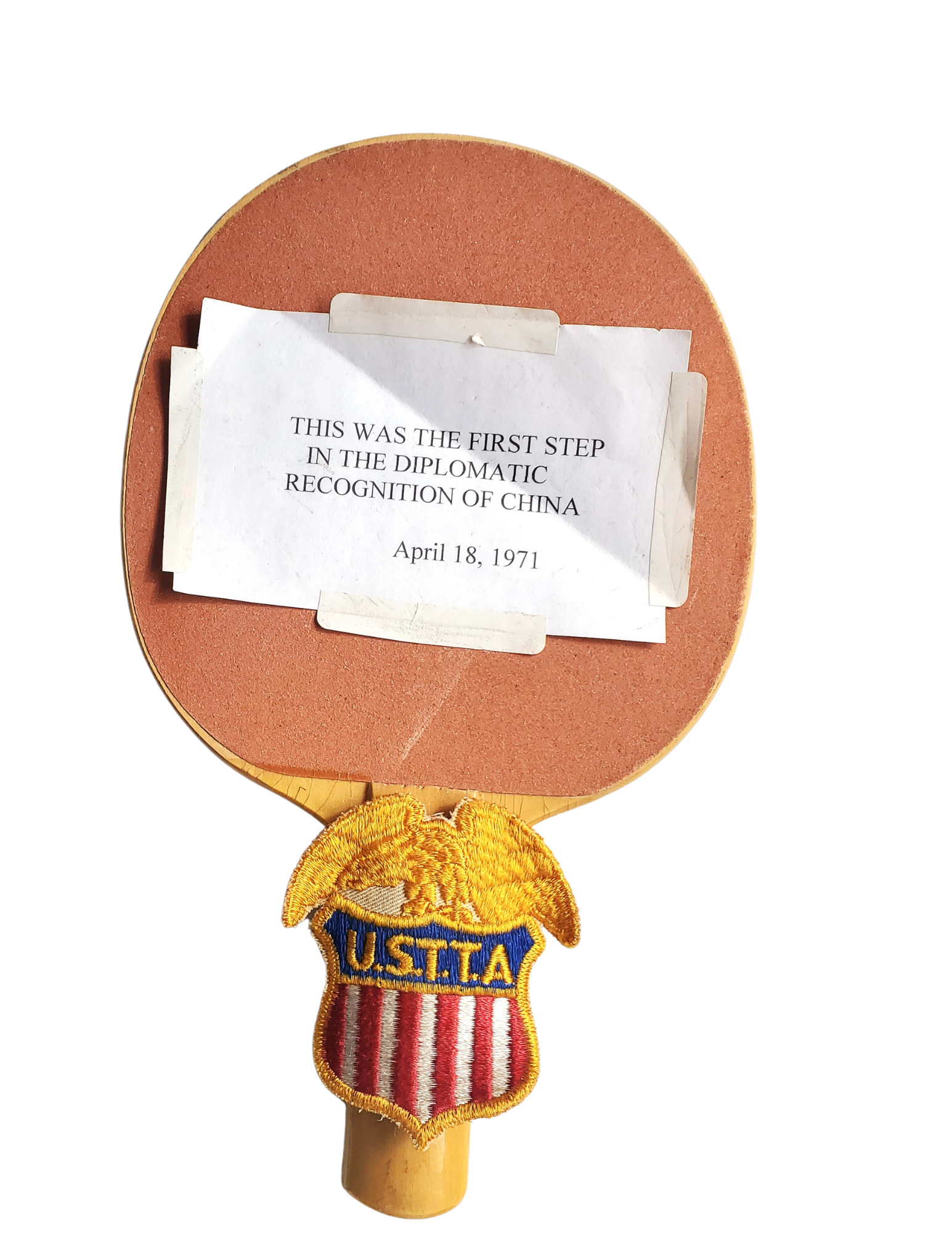
In addition, DACOR would like to thank Susan Irving, the daughter of Franklin Irving, who was the Deputy Assistant Secretary of State for the Asian and Pacific region in 1971, for the donation of a table tennis paddle (picured) used by the US Table Tennis Association (USTTA) in April 1971. This paddle represents an important diplomatic tool in US history. For more information about the paddle and Ping Pong Diplomacy, check out the April 2024 Bulletin!
Where I Was When Ping Pang Diplomacy Sparked the US-China Normalization of Relationship
By Chialing Yang, DACOR Member
In 1971, I was an 18-year-old laboring in the remote countryside of the northeastern Chinese province, Jilin, bordering North Korea. Two years ago, Chairman Mao gave the order that all middle and high school graduates should be sent to the countryside and remote border areas to be re-educated by the poor peasants, to purify our soul. I had not yet finished middle school then. Life in the village was very hard and extremely boring. We had no books, no newspapers, no television (television only came into existence in major cities in China in the late 70s and early 80s), and no entertainment whatsoever. The only connection with the outside world was a broadcasting cable connected with the commune’s public address station that occasionally had a woman reading selected news from the past-date Communist party newspapers. One day in April, on my way home from the field, I heard that voice reading the news from the party newspaper, the People’s Daily. Her high-pitched voice said that an American ping pong delegation was visiting China and touring my hometown, Shanghai, right now. I was astonished and so excited. China and the United States had not had any communication since the Communists took over power in 1949. We didn’t know what’s going on in the United States and we were taught as soon as we entered school to hate the Americans because they were imperialists. My parents were educated in the United States in the 1940s. They returned to China before the Communists won the civil war. They simply wanted to help build a better China. But in the numerous political campaigns since the liberation, they were often the targets for persecution. I had known early on, part of our family’s suffering was because of their connection with America and my grandparents had become Americans after fleeing China.
I didn’t know what to make out of this news. No American, except a few Communist sympathizers who supported the Communists since the 30s, ever visited China. Instincts told me that this was a sign of change, a major one. For me and my family, it could only be for the better. I was not absolutely sure though. I wrote to my parents. Letters took at least two weeks to turn around those days. They told me the whole story of how this all happened – the American ping pang players met the Chinese young players in Japan. Despite the government political order for the Chinese players not to directly communicate with the foreigners, the Chinese ping pang champaign Zhuang Zedong spoke with an American player and they struck a friendship. Then it was Chairman Mao who decided, instead of punishing the young ping pang player for speaking to the American, to invite the whole American ping pang team to China for a visit.
My mother was particularly excited. She wanted so much that China and America can be friends again. She called her seven years studying in America the best time of her life. I was then excited too, I wanted the change, the change that can open China and let us see more of the world, the change that can take me out of the village and let me go back to school.
In the village, the peasants were bubbly about this event too. They were such simple and honest people. They didn’t care too much about talking right politically. At the village meeting, they were competing with imagination of the excitement and sensation a bunch of big nose, blue-eyed foreigners walking on the Chinese streets could cause. They wished they were there to see. Some older men were speculating who would be better to China, the Americans or the Lao Maozi (Russians). After all, the Russians had been treated as China’s Old Brothers and strongest supporters for a long time. Now suddenly the Americans were welcomed again. The village head was a Korean War veteran, a tough guy. He said all foreigners are bad. He knew Americans because he fought them in Korea. They fought us so hard without any mercy, they could never like us Chinese! He said.
We all knew, China’s relationship with USSR had soured for a few years already and we had to dig tunnels and air raid bunkers all over the country to prepare for the Russian raid. I thought, maybe becoming friendly with America could help us not be attacked by the USSR? What I couldn’t have imagined then was, the US also wanted to get closer to China, in order to counter the USSR influence. Who could have thought, the change could be initiated in such a spontaneous way by a pair of young ping pang players, the accidental diplomats!
Ten months later in 1972, President Nixon visited China. He went to Beijing, Shanghai and Hangzhou. In Shanghai, he stayed in the Jingjiang Hotel, a block away from my parents’ home. As friendly as the Government treated President Nixon as a most distinguished state guest, my parents were ordered not to leave the house and try to speak to any American who may appear on our street. They were only allowed to leave house after the Americans had left. Such treatment would continue until the US and China formally established the relationship.

1801 F Street, NW
Washington, DC 20006
202.682.0500
© 2026 DACOR. All Rights Reserved. Privacy policy
Website Powered by MemberLeap